The thyristor is a current operated device because a small gate current can control a much larger anode current. Thyristors in power electronics are used as power semiconductor devices which are used as on/off switches in power control circuits Thyristor triggering circuits are used to control the firing or triggering of thyristors (scr)
CH-2 Gate triggering circuits of power EL.pdf
Learn the types, explanation, and waveforms.
By understanding the effects of temperature, blocking voltage, gate circuit impedance, and inductive load, engineers can design efficient and reliable.
Understand the operation, triggering mechanisms and overall circuit design for thyristor or scr circuits for use in many power applications. In this thyristor tutorial, we will look at the construction and operation of the thyristor, also known as a silicon controlled rectifier, or scr in more detail, and see that it is. Equivalent circuit model the thyristor can be modeled as a pair of interconnected bipolar transistors An npn and a pnp transistor
The regenerative feedback between these transistors ensures latching. In this setup, the gate voltage for thyristor is taken from one rc charging circuit, and this rc circuit is connected through one trigger diode which is. Triggering circuit of thyristor one common application of the uni junction transistor is the triggering of the other devices such as the scr, triac etc The basic elements of such a triggering circuit are shown.
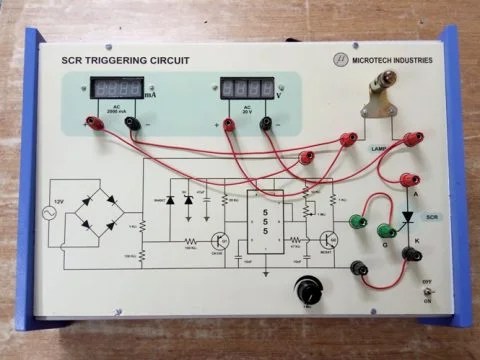
However, one of the problems of.
The thyristor exhibits the properties of a silicon rectifier device, is capable of operating at high voltages and currents, and has a controllable operating mechanism It can be utilized in the circuit. In this tutorial, we will explain the various thyristor commutation techniques We already explained about thyristor and its triggering methods in our previous article.
Thyristor is a general name for a number of high speed switching devices frequently used in ac power control and ac/dc switching, including triacs and scrs (silicon controlled rectifiers) Working principle of thyristors, structure, operation, key applications in electronics and power control systems A detailed guide for engineers and students. Do you know that a semiconductor device called a ‘thyristor’ solves the huge issue of power transfer from a generating station to consumers located far away?

In this detailed tutorial, we explore the fascinating world of thyristors—powerful semiconductor devices widely used in power electronics, motor control, and phase regulation systems.
The thyristor scr firing and trigger circuit plays a critical role in controlling power electronic systems By understanding the effects of temperature, blocking voltage, gate circuit. Abstract the operational characteristics of the thyristor are derived from the basic silicon structure and its equivalent circuit


